
Following the Pahalgam terror attack, the Indian Army launched Operation Sindoor, targeting Pakistani terror infrastructure and posts in the Poonch sector of Jammu and Kashmir. Over 600 artillery shells were fired in three days, decimating 20 Pakistani posts used for infiltrating terrorists into India. The precision strikes crippled enemy logistics, material, and morale, prompting retaliatory attacks by Pakistan on civilian areas. Despite the retaliation, Indian Army officers described the operation as a success, highlighting the high morale of the troops and the effective coordination between artillery and air defense units. The article details the intensity of the artillery shelling and the impact on both sides, highlighting the strategic significance of the Poonch sector and the ongoing tension between India and Pakistan.

Yes, the entry of private bankers, particularly with global experience will add value to PSBs, points out Tamal Bandyopadhyay.
Temples across Uttar Pradesh were packed with devotees on Sunday for Ram Navami, with Chief Minister Yogi Adityanath leading prayers at the Gorakhnath Temple. Heavy crowds were witnessed at temples in Lucknow, Gorakhpur, and Varanasi, where security was heightened. In Gorakhpur, Adityanath performed the traditional kanya pujan ritual, while in Varanasi, a 51-foot statue of Lord Ram has become a major attraction. The festival was celebrated with enthusiastic fervor across the state.

US President Donald Trump strongly condemned the terror attack in Kashmir's Pahalgam in a phone call with Prime Minister Narendra Modi and expressed full support to India to bring to justice the perpetrators of the "heinous attack". Trump conveyed his deepest condolences at the loss of innocent lives in the terror attack and said that India and the United States stand together in the fight against terror. The attack, which killed 26 people, mostly holidayers from other states, is the deadliest in the Valley since the Pulwama strike in 2019. Modi, who was on a two-day state visit to Saudi Arabia, cut short his visit and returned to New Delhi on Tuesday night after the attack.
The casualties were reported hours before India and Pakistan agreed to end hostilities, which soared after the Indian Armed Forces hit terror launchpads in Pakistan and Pakistan-occupied Kashmir earlier this week in response to the Pahalgam attack.
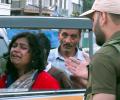
Terrorists opened fire at a popular tourist spot near Kashmir's Pahalgam town on Tuesday afternoon, killing 26 people, mostly holidayers from other states, in what is the deadliest attack in the Valley since the Pulwama strike in 2019.
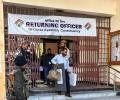
'PM Modi would have swept the elections in Kashmir after notebandi but then he scrapped Article 370 so all his good work went down the drain.'
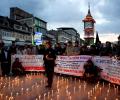
'A terrorist has no religion -- they are nothing but the face of evil. When you offer namaz for a terrorist, attend their funeral, or give them a grave, you affirm that they belong to a religion. That must stop'

Five army personnel were killed and six injured on Monday when terrorists ambushed their vehicle in the remote Machedi area of Jammu and Kashmir's Kathua district, officials said.
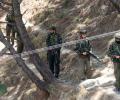
A police team came under fire from terrorists during a combing operation in Kathua district of Jammu and Kashmir on Monday night. The encounter led to a night cordon being laid to prevent the three terrorists trapped in the forest from escaping. Deputy Inspector General Shiv Kumar Sharma said the operation would continue until the last terrorist is neutralized, urging people near the border to report suspicious activities.
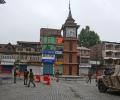
Raj Kumar Thapa, additional district development commissioner, Rajouri, and his two staff members were seriously injured when an artillery shell hit his official residence in Rajouri town, the officials said.

A UN Security Council report states that The Resistance Front (TRF) claimed responsibility for the Pahalgam terror attack and published a photograph of the attack site. The report also cites assertions that the attack could not have happened without the support of Pakistan-based Lashkar-e-Tayyiba (LeT).
After retirement, Desle toured a couple of places but visiting Kashmir was his dream, said 60-year-old Nerkar who used to do yoga with his friend regularly.
He went on to say that even though this has not been discussed, he is going to 'increase trade substantially with both of these great Nations.'
'It was inspired by the Hamas attack and was like their attack -- well planned and well executed.'

Manoj Tiwary said that India should boycott the much-talked-about fixture against their arch-rival Pakistan in the upcoming Asia Cup.

A father searches for his missing daughter after a devastating cloudburst in Kishtwar, Jammu and Kashmir, which killed dozens and left many others untraced.
Mock drills were conducted on Saturday in states and Union territories adjoining the western border -- from Jammu and Kashmir to Gujarat -- to enhance wartime emergency preparedness and response capabilities, officials said.

Prime Minister Narendra Modi held a meeting with National Security Advisor Ajit Doval and External Affairs Minister S Jaishankar upon his arrival from Saudi Arabia to take stock of the situation following the terror attack in Pahalgam, Kashmir. The meeting also included Foreign Secretary Vikram Misri. The attack, which killed at least 26 people, including tourists from the UAE and Nepal, has sparked nationwide shock and outrage.
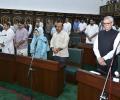
The Jammu and Kashmir assembly unanimously passed a resolution on Monday expressing shock and anguish over the terrorist attack in Pahalgam and resolved to fight resolutely to defeat the nefarious designs to disturb communal harmony and hinder progress.

Sarma had earlier said the state-wide crackdown on traitors would continue, and nobody would be spared.
Four recent encounters in Jammu and Kashmir's Kathua district have exposed the route used by terrorists to infiltrate into India from across the International Border (IB), a senior police officer said. The successful recovery of huge quantities of arms and ammunition, including explosives, after the gunfights has scuttled a major plan of the terror groups to carry out a major strike in Jammu and Kashmir.

Jammu and Kashmir Chief Minister Omar Abdullah announced plans to build a memorial in Baisaran, Pahalgam, in memory of the 26 victims of last month's terror attack. The memorial will serve as a lasting tribute to the victims and a reminder that they will never be forgotten. Abdullah also addressed the importance of reviving tourism in the state, assuring tour operators that tourist destinations will reopen in a phased manner.

People along the Line of Control and International Border in the Jammu region continue to live under the shadow of death, with unexploded mortar shells fired by Pakistani troops still embedded in farmlands and residential areas even though hostilities have stopped for nearly a week. IMAGE: Kindly note that this image has been posted for representational purposes only. Photograph: / Rediff.com Despite the May 10 understanding between India and Pakistan, locals describe the border areas as a 'death trap'. Sixty-two-year-old Balvinder Singh, who returned to his home in Pargwal sector on May 14, recounted a narrow escape. "Two shells exploded in our compound, damaging our house. Three more landed on our farmland. We were terrified and told our family to stay away from the fields until the Army could help," Singh told PTI. Army engineers later came to the village and safely defused the unexploded shells, bringing a temporary sense of relief. "Fear is writ large on the faces of people to these death traps in border hamlets", he said. Scenes of destruction are evident rooftops torn apart, broken houses, windows punctured by shrapnel, and carcasses of cattle lying in pools of blood. The acrid smell of gunpowder still lingers in the air. Sardar Gurmeet Singh faced a similar ordeal. His family could not re-enter their home as a live mortar shell had sunk into the compound in a village close to the International Border. "The army's bomb disposal squad removed it after four days, allowing us to finally enter, back home," he said. Indian Army engineers have launched a sweeping clearance operation across border districts, defusing over 80 unexploded shells in the past five days -- including 6 in Pargwal, 19 in Rajouri, 42 in Poonch, and 12 along the IB. "These shells, mostly 120 mm calibre, have a range of 15 to 30 km and pose a serious threat to both civilian and military targets," an Army officer said. "Many of them were fired by Pakistan during recent hostilities." On May 7, the Indian Army launched Operation Sindoor, conducting precision strikes on nine terror hubs in Pakistan and Pakistan-occupied Jammu and Kashmir (PoJK) in response to the April 22 terror attack in Pahalgam that killed 26 people, most of them tourists. The subsequent retaliation by Pakistan pushed the region to the brink of war. From 7 to 10 of May, 27 civilians were killed and over 70 injured in Pakistani shelling in the Jammu region. Farid Din Gujjar, a resident near the border, expressed fear about returning to his fields. "Several shells created deep craters in our paddy land. We cannot resume work until all unexploded ordnance is cleared. It's a death trap," he said. Army units, in coordination with Jammu and Kashmir Police, have evacuated high-risk zones and issued stern warnings to residents not to touch any suspicious objects or unexploded shells. In one major operation, 42 live shells were safely destroyed in the Poonch villages of Jhullas, Salotri, Dharati and Salani. "All safety protocols were followed. The shells posed a serious danger to local lives," an Army spokesperson said, calling the effort a 'continued commitment to protect civilians and restore normalcy'. Poonch saw the vast majority of deaths due to shelling. Security officials said that Pakistan used a mix of mortar shells, armed drones, and missiles during the shelling spree, specifically targeting civilian habitations and border towns in Jammu, Samba, Kathua, Rajouri, and Poonch. As clearance operations continue, the border residents are slowly returning to their homes, but with caution, fear, and lingering uncertainty about shelling that may yet happen in the future.

However, there has been an appreciable decline in the casualties of civilians and security forces in the terror attacks in the past nearly four years. Against 11 civilian killings from October 27, 2015 to August 4, 2019, there was a 63 per cent decrease with seven civilian killings reported post the abrogation of Article 370.

The empty cartridges found at Pahalgam and those after test firing by the recovered guns were matched by the forensic lab, Shah said. The ballistic report is with him, he added.
The Congress Working Committee (CWC) condemned the Pahalgam terror attack, calling it a direct assault on the values of the republic. The party accused the BJP of exploiting the tragedy to promote discord and polarization, while urging for unity and solidarity in the face of adversity. The CWC also demanded a comprehensive analysis of the intelligence failures and security lapses that led to the attack.
'India today feels enough is enough and we need to teach Pakistan a lesson.' 'Unless compelled, Mr Modi will think 10 times before taking the extreme step.'

The National Investigation Agency (NIA) has started interviewing eyewitnesses, including tourists, in connection with the deadly terrorist attack in Pahalgam, south Kashmir. The attack, carried out by terrorists from the Pakistan-based Lashkar-e-Taiba (LeT), claimed the lives of 26 people on April 22. Initial investigations suggest that five to seven terrorists were involved, aided by local militants trained in Pakistan. Security forces are conducting massive operations to hunt down the terrorists in the dense jungles of the Pir Panjal range.
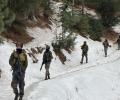
Two terrorists, including a top commander of the Pakistan-based Jaish-e-Mohammad (JeM) outfit, were killed in an ongoing operation in a snow-bound area of Jammu and Kashmir's Kishtwar district. The operation began on Wednesday following a brief encounter and continues. A separate operation to track down three other terrorists has also been underway in Udhampur district since Wednesday.
India's sporting fraternity, including Olympic medalists Neeraj Chopra and PV Sindhu, expressed grief and condemnation over the deadly terrorist attack in Pahalgam, Kashmir.

Pakistan military spokesperson Lieutenant General Ahmad Sharif Chaudhry told a hurriedly called press conference in Islamabad at around 4 am that th Pakistan air force's Nur Khan (Chaklala, Rawalpindi), Murid (Chakwal) and Rafiqui (Shorkot in Jhang district) airbases were targeted.
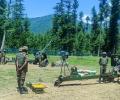
'The precision strikes were well planned and excellently executed. The world will be studying this operation.'
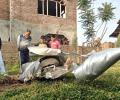
Two more persons have been apprehended in Assam for "sympathising with Pakistan, taking the total number of arrests to 58 so far in the wake of the Pahalgam terror attack, Chief Minister Himanta Biswa Sarma said.

It is learnt that the home minister will review the area domination plan, zero terror plan, law and order situation, cases related to UAPA and other security-related issues.

The body of a 22-year-old man was found in a river in Jammu and Kashmir's Kulgam district, sparking allegations that he was picked up by security forces for questioning after a terror attack. PDP leader Mehbooba Mufti, National Conference Lok Sabha member Aga Ruhullah Mehdi, and Jammu and Kashmir Minister Sakina Ittoo have demanded a judicial probe into the death of Imtiyaz Ahmad Magray.

Lashing out at Abdullah and Mehbooba Mufti, Rashid on Wednesday alleged that they have "destroyed" Kashmir.

'We have arranged for extensive security around the stadium and its periphery. Today, there was a review of it.'

Days after the Pahalgam terror attack, Jammu and Kashmir authorities have deported 59 Pakistani nationals, including the mother of Shaurya Chakra awardee Constable Mudasir Ahmad Sheikh. The Pakistani nationals were living in the valley for decades and were transported to Punjab for repatriation. However, the mother of the deceased soldier was later allowed to stay back. The deportation comes after the Indian government announced a slew of measures against Pakistan in the wake of the Pahalgam attack, including the suspension of the Indus Waters Treaty and the downgrading of diplomatic relations.
